
Vintage Celestial Globe by Philips' 12inch Circa 1935
Pickup currently unavailable
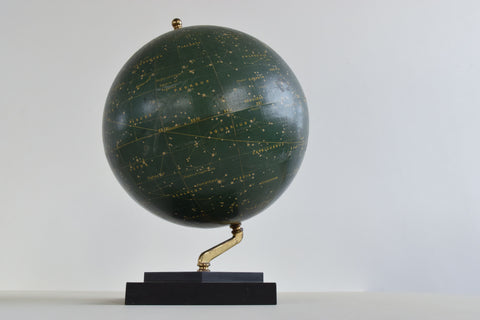



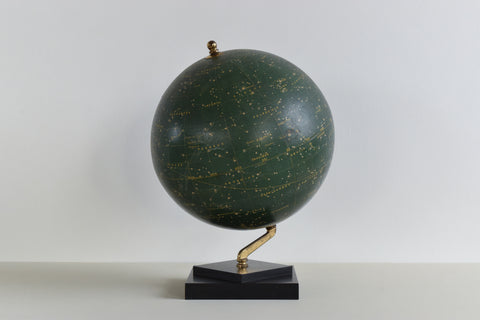
Globes have to be one of our favourites things here at Absolutely Nice HQ. Their colours, functionality and craftsmanship tick all the right boxes. If you search for 'Globe Making (1955)' in YouTube there are a couple of amazing videos by British Pathé well worthy of a watch.
Before a time when you could just type in a location on a computer and see every nook and cranny at street level, you had to rely on your trusty globe to see where Burkina Faso or Azerbaijan were.
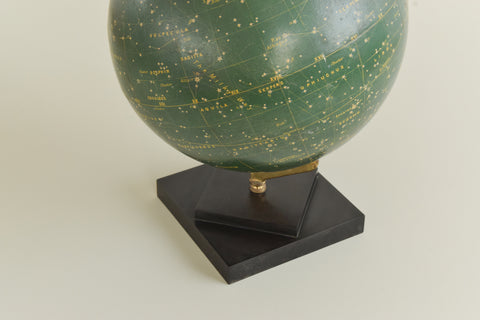
With a lovely original stepped bakelite base, this circa 1935 Philips' 12 inch celestial globe would be a beautiful addition to any home, study or office. Measures approximately 41cm tall and 30cm wide.
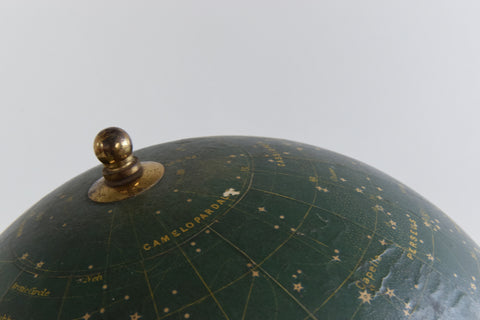
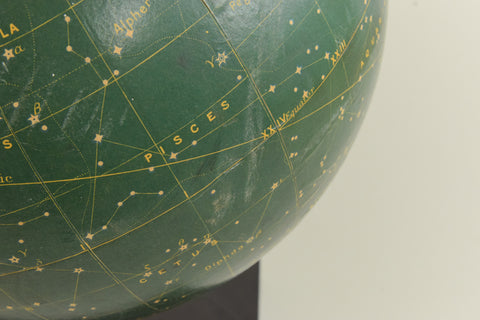
The globe is printed in beige against a dark green background and shows the constellations and many named stars. Fine lines connect the stars within constellations rather than illustrating them as mythological and other figures.
Although the globe is in good condition it is not without wear commensurate with age and use. As a result there's pitting, stains and marks all over the globe along with the odd tear to the paper here and there and as photographed.
The text within the label reads 'Philips' 12 inch Popular Celestial Globe Magnitudes 1st 2nd 3rd 4th 5th. George Philip & Son Ltd, 32, Fleet Street, London.'
George Philip & Sons was founded in 1834 in Liverpool by George Philip (1800-1882) primarily as a publisher of maps and atlases and celebrated its 150th anniversary in 1984.
Its production of globes in the 19th century was mainly limited to associations with other British globe makers, including Smith & Sons, London.
In 1902 Philip ventured into globe manufacture, facilitated by the firm's establishment of the London Geographical Institute, a large factory for map, atlas, and globe production.
Over the years, Philip has acquired the production lines of other British globe makers including Malby, Betts, Smith and Johnston.